Junwon Kim.
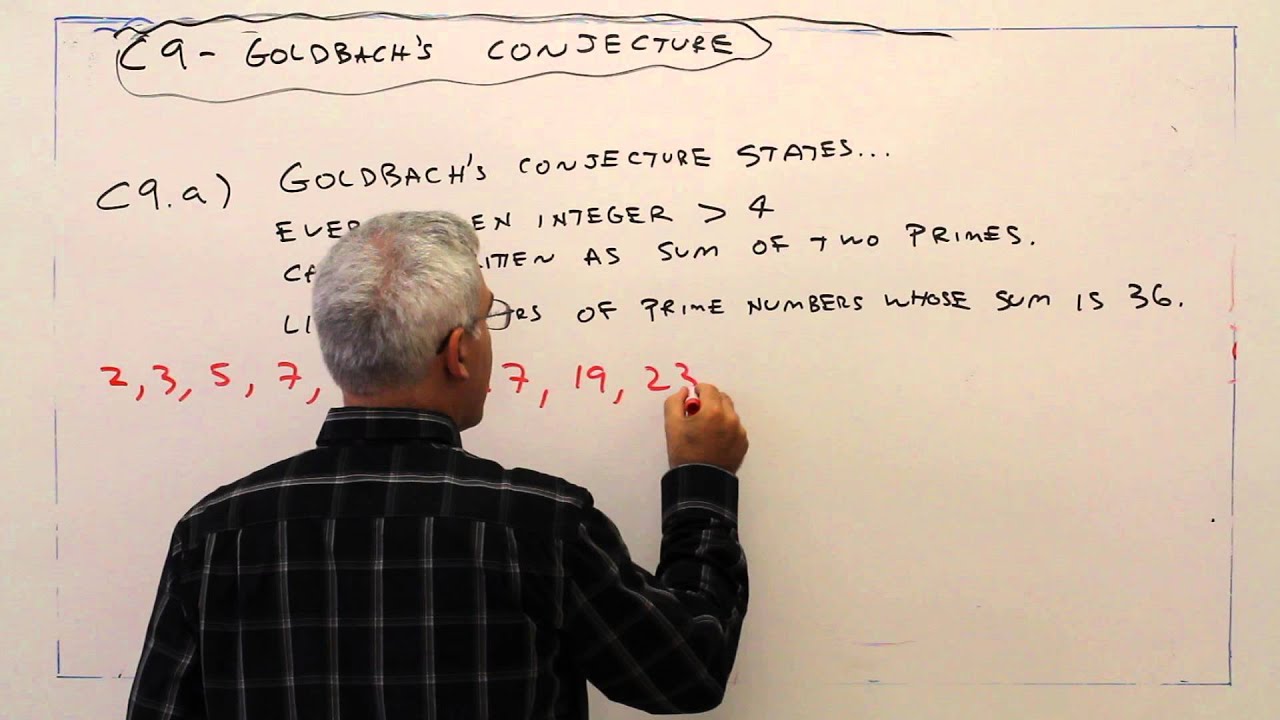
Goldbach's conjecture
Problem Solving
Goldbach's conjecture
Goldbach's conjecture is one of the oldest and most famous unsolved problems in number theory and mathematic
What is Goldbach's conjecture?
Every even integer greater than 2 can be written as the sum of two prime numbers.
The conjecture was first proposed in 1742 by the German mathematician Christian Goldbach. In a letter to the renowned mathematician Leonhard Euler, Goldbach suggested that every integer greater than 2 can be written as the sum of three prime numbers. Euler replied, reformulating the conjecture into a simpler and more famous version: Every even integer greater than 2 can be expressed as the sum of two prime numbers.
For example:
4 = 2 + 2
6 = 3 + 3
8 = 3 + 5
20 = 7 + 13
Implementation
#include <bits/stdc++.h>
using namespace std;

void che(bool arr[], int size)
{
    arr[0] = true;
    arr[1] = true;

    for (int i = 2; i * i < size; i++)
    {
        if (arr[i] == true)
            continue;
        for (int j = i * i; j < size; j += i)
        {
            arr[j] = true;
        }
    }
}

int main()
{
    freopen("template.in", "r", stdin);
    freopen("template.out", "w", stdout);

    bool *arr = new bool[1000001];
    che(arr, 1000001);
    int n;
    bool hasAns = false;
    while (cin >> n != EOF)
    {
        if (n == 0) {break;}

        for (int i = 3; i < n; i += 2)
        {
            if (!arr[i] && !arr[n - i])
            {
                hasAns = true;
                printf("%d = %d + %d\n", n, i, n - i);
                break;
            }
        }

        if (!hasAns)
            printf("\nGoldbach's conjecture is wrong.\n");
    }
}